


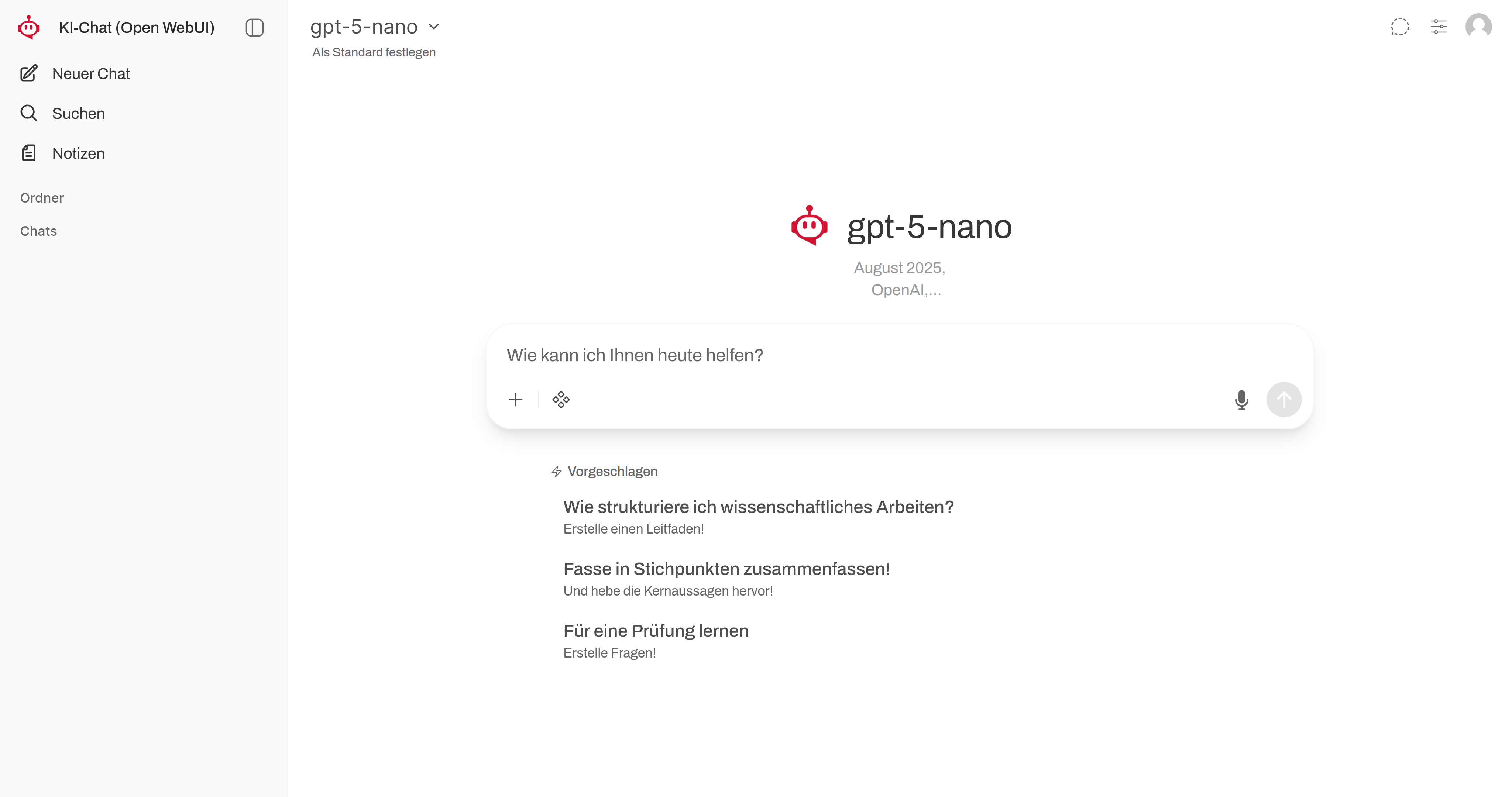

AI-Chat
In the AI chat at HWR Berlin, a selection of different language models of text-generating artificial intelligence (AI) is available.
Artificial Intelligence at HWR Berlin
The page ki.hwr-berlin.de is dedicated to a critical examination of generative artificial intelligence (AI), its significance for shaping teaching and learning, and the provision of tools. The focus is on analyzing and discussing the effects on teaching and learning processes as well as on examination and assessment methods. The aim is to provide well-founded input for the further development of teaching formats, to systematically consider both opportunities and risks, to raise awareness of the growing importance of AI, and thereby to support students, instructors, and staff.
Use AI at HWR Berlin responsibly: Our policy provides clear guidelines for ethical, legal, and data-protection-compliant use.

In addition, follow the requirements set by instructors/examiners and the faculties regarding the use and labeling of AI.

Use AI responsibly
Basics of Artificial Intelligence
In this five-part video series, central aspects of artificial intelligence are explained in an easy-to-understand way. The topics range from technical basics to societal questions, as well as practical applications in organizations, creativity, and research. The focus is not only on opportunities, but also on challenges: How can AI be used responsibly? What ethical, legal, and cultural questions do we need to consider? The accompanying article provides a compact overview, places the video content in context, and invites you to understand AI as a tool we can shape in the present time.
“Generative AI calculates likely content; it does not generate knowledge.”
Technische Grundlagen
Was genau ist Künstliche Intelligenz – und wie funktioniert sie? In diesem Video erklären wir die technischen Grundlagen von KI und generativer KI leicht verständlich: von den zentralen Bausteinen wie Daten, Algorithmen und Rechenleistung bis hin zu maschinellem Lernen, neuronalen Netzen und Deep Learning. Anhand anschaulicher Beispiele zeigen wir, wie KI bereits heute in unserem Alltag wirkt – etwa in Sprachassistenten, Navigationssystemen oder Empfehlungstools. Außerdem werfen wir einen Blick auf die verschiedenen Arten von KI – von einfachen reaktiven Systemen bis hin zur theoretischen Vision einer selbstbewussten Superintelligenz. Das Video bietet einen kompakten Überblick über den aktuellen Stand der Technik und beleuchtet zugleich die Herausforderungen, die mit der weiteren Entwicklung leistungsfähiger KI-Systeme verbunden sind.
Gesellschaftliche Reflektion
In diesem Video werfen wir einen kritischen Blick auf die gesellschaftlichen Auswirkungen von Künstlicher Intelligenz. Neben technischen Fortschritten bringt der KI-Einsatz auch ethische, rechtliche und kulturelle Herausforderungen mit sich. Wir beleuchten Fragen der Verantwortung bei KI-Entscheidungen, Risiken durch diskriminierende Algorithmen und die Bedeutung von Datenschutz und Regulierung. Zudem thematisieren wir, wie KI unsere Arbeitswelt verändert und welche Auswirkungen sie auf unser Selbstbild und gesellschaftliche Rollen haben kann. Ziel ist es, ein Bewusstsein für eine verantwortungsvolle Integration von KI zu schaffen. Der Beitrag ruft zu einer gemeinsamen Reflexion aller gesellschaftlichen Akteure auf, um klare Leitlinien zu entwickeln, die den technologischen Wandel mit unseren ethischen Werten und gesellschaftlichen Zielen in Einklang bringen.
Kreative Inhalte gestalten
Künstliche Intelligenz verändert die kreative Arbeit. In diesem Video zeigen wir, wie KI bei der Gestaltung von Texten, Bildern, Musik und Filmen als Inspirationsquelle und Werkzeug dient. Ob durch Bildgeneratoren, Musikkomposition oder Textvorschläge – moderne KI-Modelle wie GANs, Transformer und Autoencoder eröffnen neue kreative Möglichkeiten. Dabei bleibt der Mensch im Zentrum der Gestaltung. Wir beleuchten die Technologien, zeigen konkrete Anwendungsbeispiele aus Kunst, Musik, Literatur und Film und gehen auf zentrale Herausforderungen ein – von Urheberrecht über Datenqualität bis zur Integration in kreative Arbeitsprozesse. Das Video bietet einen praxisnahen Überblick, wie man KI kreativ und verantwortungsvoll einsetzen kann – für neue Ideen, effizientere Abläufe und inspirierende Ergebnisse.
Organisation und Automatisierung
Dieses Video zeigt, wie Künstliche Intelligenz Organisationen und Bildungseinrichtungen unterstützt. KI wird genutzt, um Daten zu analysieren, Prozesse zu automatisieren und Entscheidungen zu optimieren – sei es bei Wartungsplänen, Lernpfaden oder Ressourcenverteilung. Durch maschinelles Lernen, automatisierte Bewertungen und Promptbibliotheken lassen sich Arbeitsabläufe deutlich effizienter gestalten. Doch mit dem technologischen Fortschritt wachsen auch die Anforderungen: neue Kompetenzen, hybride Arbeitsmodelle und agile Strukturen sind gefragt. Zudem gilt es, Herausforderungen wie Datenschutz, Datenqualität und Change Management zu meistern. Die enge Zusammenarbeit zwischen IT und Fachabteilungen ist dabei entscheidend. Das Video bietet einen praxisnahen Einblick, wie KI den Wandel in Wirtschaft und Bildung mitgestaltet – und wie man diesen Wandel erfolgreich und verantwortungsvoll umsetzt.
Recherche und Datenanalyse
Dieses Video zeigt, wie Künstliche Intelligenz Recherche und Datenanalyse revolutioniert. Ob in Wissenschaft, Wirtschaft oder Bildung – KI-Systeme unterstützen bei der Informationssuche, Datenaufbereitung und Visualisierung komplexer Zusammenhänge. Im Vergleich zu klassischen Suchmethoden liefern sie kontextbezogene, strukturierte Ergebnisse und helfen dabei, Trends oder Muster schneller zu erkennen. Die Kombination aus automatisierter Analyse und menschlicher Bewertung ermöglicht fundierte Entscheidungen. Ein besonderer Fokus liegt auf dem sogenannten „Prompt Engineering“: Durch gezielte Eingabeanweisungen lassen sich KI-Ergebnisse präzise steuern und verbessern. Zudem thematisiert das Video wichtige Aspekte wie Quellenkritik, Ergebnisvalidierung und Transparenz. So wird deutlich, wie KI als leistungsfähiges Werkzeug zur Wissensgenerierung beitragen kann – bei gleichzeitiger Wahrung wissenschaftlicher und ethischer Standards.
AI pilot phase
Since the introduction of HAWKI in the winter semester 2024/25, members of HWR Berlin have had access to generative AI in accordance with the GDPR.
In parallel to the year-long pilot phase with HAWKI, alternative solutions were still being sought that would better meet the general requirements.
With the provision of the new AI chat based on Open WebUI, a structured transition is being initiated: HAWKI will be phased out step by step at HWR Berlin and will be scheduled to end by summer semester 2026.
FAQ
Frequently asked questions
Are personal data sent to OpenAI?
No. OpenAI only receives the prompts you enter. Neither user data nor IP addresses are shared because the HAWKI server handles the forwarding. The use is anonymous, which means storing chat histories on a user account is not possible.
Are data backed up, monitored, or analyzed?
No. There is no storage, monitoring, or analysis of data. Your inputs are not used to train the AI at OpenAI, which is ensured by specific settings in the API. However, for technical analysis of misuse and misappropriation, OpenAI will retain your anonymous requests on the OpenAI servers for up to 30 days.
Do costs arise from using it?
The HWR Berlin covers the costs. They are calculated based on the word count of your inputs plus the responses.
So asking short and precise questions saves money!
Are there rules for use?
Yes, the main rules are:
- Do not include personal data in your prompts.
- Do not include copyrighted material in your prompts.
- Use of HAWKI is permitted only within the scope of your studies or official duties.
The terms of use must be followed.
Are there recommendations for dealing with the results?
The answers from generative AI are largely correct, but they can also be outdated, wrong, or even fabricated. Users are responsible for checking the results for accuracy. Directly using the results is not recommended. Decisions should not be made solely on the basis of generative AI’s outputs. Learn about how generative AI works in general, as well as its advantages, disadvantages, and risks.
Will there be more language models?
The available portfolio of language models changes regularly because the provider releases new versions and removes outdated models. Once a model is discontinued by the provider, it is no longer available in our AI chat.
We commit to integrating new models into our system only after a thorough review with regard to data protection and data security.
Generative AI
An area of artificial intelligence that focuses on models capable of generating content—such as texts, images, music, or code—that resembles what humans might create.
Prompt
A prompt is an input or a starting text that you give to an AI to receive a response or a continuation. It serves as guidance for the AI so it understands the context or topic it should respond to.
Prompt-Engineering
Prompt engineering is the process of creating and optimizing input prompts for AI in order to get the desired answers or results. It involves carefully wording and adjusting the prompts to encourage the AI to provide as precise, relevant, and high-quality responses as possible. The goal of prompt engineering is to make the best use of the AI’s capabilities and to steer the output.
Finetuning
Fine-tuning in the context of AI—especially with text-generating models—means adjusting or further developing a pre-trained model using specific data so that it performs better for particular tasks or applications.
Machine learning (ML)
A method of AI that uses algorithms to learn from data and make predictions or decisions without being explicitly programmed.
Deep Learning
A subgroup of machine learning based on artificial neural networks with many layers (“deep”). Deep learning models are particularly effective at processing image, video, and speech data.
Neural network
A network of artificial neurons, inspired by the structure and function of the human brain, used to build and train ML models.
Reinforcement Learning (RL)
A type of machine learning in which an agent learns to act in an environment by optimizing its actions based on rewards.
Natural Language Processing (NLP)
An area of AI that deals with the interaction between computers and human (natural) language—especially how to teach computers to read, understand, and generate human language.
Text-to-Image Generation
The use of generative AI models to create visual content based on textual descriptions.
Glossary
explained simply